The Metacrisis is a Degradation of Evolvability: Why Global Risk Needs Evolutionary Explanation and Governance

Introducing our new preprint on evolutionary governance for systemic and global catastrophic risk
By Matt Boyd

TLDR/Summary
- Nothing about human society and its generation of global risk makes sense except in the light of evolution. I’ve been building that claim through my recent posts and conference talks.
- A new preprint I’ve developed with Nick Wilson, and now under peer-review, brings all this together in a technical paper: The Metacrisis as a Degradation of Evolvability.
- Five research communities working on global risk are converging, often unawares, on the extended evolutionary framework. We name it, systematise it from first principles, and draw out what it implies for governance of global risk.
- Risk-generating architectures recur wherever certain evolutionary dynamics obtain; the metacrisis is the simultaneous degradation of five conditions of evolvability (variation, modularity, selective-environment stability, transmission fidelity, and outlaw/defector suppression)
- Global risk governance must therefore act on those conditions, above all on suppressing defectors.
- The evolutionary lens is not the answer to everything, but our paper deliberately pushes it as far as we can, because evolution keeps seeping through the gaps in other explanations and joining them together.
- The upshot is a change in what governance is for: less for specifying solutions, and more about engineering, nudging and continually readjusting the conditions under which good solutions can arise, spread and hold.
Two intellectual strands twisted together
This post has been a long time coming. In 2007 I wrote a Masters thesis in philosophy, on cultural evolution and the information environment we have created. That was back when “meme” still had a technical definition, Dawkins’s unit of cultural inheritance, and did not yet mean a picture of a cat that goes viral. My thesis argued meme theory was useful in understanding how culture evolves.
My 2011 PhD took the next step: technologies play a privileged causal role in psychological development, and as we invent new ones, we change the developmental environment for present and subsequent generations, thereby driving evolution of the mind, cumulative niche construction applied to human cognition.
Both theses were under Kim Sterelny, whose work on cumulative culture runs through our new preprint too.
For over a decade since, I have worked on global catastrophic risk, studying pandemics, nuclear winter, island refuges, and national risk assessment. It was seemingly inevitable that the two strands; evolution and global risk would meet.
Dobzhansky said nothing in biology makes sense except in the light of evolution.
I’ll appropriate that: nothing about human society, and about why it keeps generating risks we know how to avoid, makes sense except in the light of evolution.
Regular readers of this blog will have seen the argument assembling. In February I asked whether there is really a “meta”-crisis. In May I presented an early version of this argument at a European risk-analysis conference. In July I wrote a definitional field guide following a chain of four questions:
- What could go badly wrong? That’s global catastrophic risk.
- How do failures spread? That’s systemic risk, where a tightly-coupled world is a generator of hazards, not a bystander.
- How do crises compound? That’s polycrisis, the causal entanglement of crises such that the whole is worse than the sum of its parts.
- And why do we keep generating a fragile world?
I now turn to this fourth question.
Rising global risk despite known fixes
The major global hazards were identified decades ago, and so were fixes: disarmament, emissions reduction, health-security investment, limits to extraction. The Club of Rome laid much of it out in 1972. Yet emissions have risen since the Paris Agreement, arms-control treaties have lapsed, and by most measures the world is more exposed. Humanity is not ignorant of what threatens it. What’s missing is second-order understanding: why we consistently fail, and at what level to intervene.
Five fields, one grey elephant
Our new preprint begins by outlining the communities working on these problems of global risk. National risk assessment and disaster risk reduction handle hazards, mostly natural, mostly after the fact. Global catastrophic risk studies confront rare but devastating events. Systemic-risk analysis maps feedback-rich networks and names risk-creating actors. Polycrisis scholarship traces entanglement and attractor states, including the Cascade Institute’s “Illiberal Decline” and “Mad Max” basins. Behavioural and evolutionary science speaks of traps, ratchets and a “human behavioural crisis”.
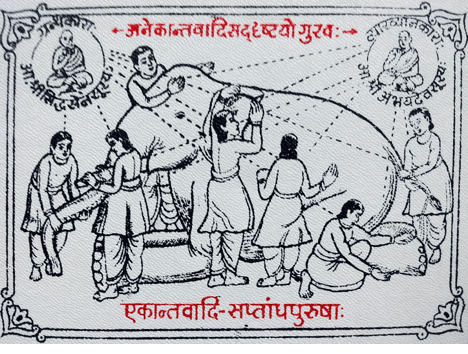
Each field is like a blind monk with a hand on an elephant, describing in rich detail what they feel, but unable to articulate the whole. Each field reaches for the same vocabulary of adaptation, selection, co-evolution, traps, ratchets. Some is generic systems talk. A surprising amount is specifically evolutionary, used by fields with no evolutionary self-conception. That is latent Darwinism and it signals intellectual convergence.
Evolution is not a metaphor here
In risk science, grey elephants are a metaphor for big obvious risks, charging right towards us, that everyone can see plainly, yet no one acts.
In our pre-print evolution is not a metaphor. We deploy a precise version of evolution, not a simplified high school one, and certainly not the discredited “Social Darwinism” that confused selective success with moral merit.
Natural selection is an abstract process that arises wherever there is heritable variation, differences in success that depend on it, and differential persistence as a result. Dennett called this substrate neutrality: the logic doesn’t care what the variants are made of. Genes are one substrate. Firms, institutions, legal codes, professional norms, technologies and ideas are others, to varying degrees. Bicycle design lineages show the adaptive-radiation signature of biological clades, and no designer intended it.
This instantiation comes in degrees, and where any human system sits on Godfrey-Smith’s continuum of “Darwinian populations” is an empirical question. But human systems are also designed, meaning that intention and the invisible hand of evolution operate simultaneously. Because no actor can intend outcomes everywhere and all the time, much of what results in human systems evolved rather than being designed.
This is where the social sciences fit, and our framing does not replace economics, political science or the study of human decision-making. Those describe real mechanisms, and human choice is a genuine causal element in the system. What evolution adds is the ultimate level of explanation, in Mayr’s sense, not how each mechanism or complex system feature works but why it exists and persists, shaping power and possibility.
Deliberate decisions exist in a selective environment that determines which decisions get retained and copied. The framework is “extended” because inheritance runs through several channels at different speeds (genes, memes, laws, education syllabi, technologies), because we actively construct the niches that then impose selection back on human activities, and because not all cultural change is adaptive. For example, prestige, conformity and familiarity spread variants regardless of merit.
Why we keep building a fragile world
Our new paper groups global risk by examples of its driving dynamics rather than by hazard.
- Multilevel selection. What’s adaptive for one actor (individual, firm, nation) is often destructive for the commons that sustains it. Muir bred hens individually for egg yield and got flocks that feather-pecked and cannibalised themselves. Selecting whole cages for productivity produced cooperative, higher-yield flocks. Scale that up and you have excessive carbon emissions, overfishing, aquifer depletion, and antimicrobial resistance. Firms are rewarded for maximising extraction even when run by people who grasped the consequences decades ago.
- Arms races. Red Queen dynamics where everyone must invest more merely to hold position. In frontier AI, safety spending is individually costly and competitively detrimental if an organisation’s rivals don’t match it, so the field races to deploy. Non-reckless actors are simply outcompeted. Global risks from nuclear weapon stockpiling and gain-of-function research share this structure.
- Lock-in and fitness traps. Configurations stable under current pressures but globally suboptimal, can be hard to leave because improving requires first getting worse. Fossil fuel infrastructure is the obvious case, where build out has constrained changes that are now possible.
- Transmission bias. Cultural evolution selects for what is readily learned and passed on, not for what is true, and engagement-optimised platforms erode the shared map of reality on which collective action depends and the information scaffolding which centuries of cultural evolution had built.
These are not accidents or failures of will. They are predictable outputs of evolutionary selection at several scales at once. Where the selective environment has been deliberately re-engineered, on the other hand, the Montreal Protocol, verified arms control from the late 1980s, Ostrom’s management of the commons, the dynamics have sometimes been beaten. In each case a suppression or coordination mechanism was built and protected, converting locally advantageous defection into a losing move.
Evolvability, and Metacrisis defined
Evolvability is a system’s capacity to generate, transmit and retain complex adaptations. Biological theory and computer science treat it as something that must be built into a system, not assumed. It rests on five conditions:
- Variation: a supply of diverse candidate solutions
- Modularity: semi-independent parts that can change without dragging the whole down
- Stability of the selective environment: pressure consistent enough for adaptation to accumulate
- Fidelity of transmission: reliable inheritance of what works, with error-correction
- Outlaw/defector suppression: containment of entities that gain locally by breaking cooperative rules or exploiting commons
A definition of the metacrisis follows: the metacrisis is the simultaneous degradation of these conditions in the systems meant to govern or mitigate global risk.
This is not any particular crisis, or even a polycrisis, but a crisis of the capacity to adapt to crisis at all. That is why governance fails consistently across unrelated domains.
Each evolvability condition is observable. Food-system homogenisation onto a few crops and chokepoints is a variation failure. The Tōhoku earthquake, Suez canal blockage and Hormuz fuel crisis rippling through stripped-out supply chains are modularity failures. Policy reversal each electoral cycle is a stability failure that selects against long-horizon investment. The pandemic plans and stockpiles accumulated after SARS in 2003 and the 2009 pandemic, then largely lost before 2020, are an inheritance fidelity failure.
Importantly, evolvability is value-neutral, given that a cancer can be highly evolvable inside the body. So, capacity for evolvability must be paired with a fitness function worth sustaining, and what fast cultural evolution actually selects for is rarely wellbeing or planetary sustainability, but profit, votes, engagement or military advantage. Also, evolvability sits at an interior optimum. If there is too much variation then inheritance is destroyed, if too much stability then maladaptation can become entrenched. As an example, German scientific forestry optimised what it could count and discovered, rotations later, the ecological relationships it had discarded.
Outlaws, and the lesson from cancer
Defector/outlaw suppression matters most, not only is suppressing outlaws constitutive of evolvability (multiplication of rogue genes that degrade organism fitness, across generations, is a biological example of ‘outlaws’), but outlaw activity can undermine the other necessary criteria. At every major evolutionary transition, from cells to organisms to societies, the higher-level unit exists only because it continually constrains, regulates, or suppresses, lower-level strategies that benefit themselves at the expense of the whole.
That is a decisive argument against purely non-interventionist, market-only solutions to large scale risk.
An outlaw need not be conscious or act illegally, since firms externalising costs, states leaving treaties, platforms amplifying misinformation, or farmers applying excess nitrogen fertilizer, may be responding to legitimate incentives.
Increasingly, though, outlaws attack the suppressors. At the height of the US opioid epidemic, wholesalers did not evade the DEA, instead they disabled it through lobbying, a revolving-door attorney and a 2016 statute. All this is the governance analogue of a tumour co-opting the immune cells sent to kill it.
Cancer’s evolutionary biology supplies four transferable principles against this kind of defection, namely:
- Redundant, multi-layer suppression (single point solutions are insufficient)
- Calibrating rather than maximising enforcement, since maximal enforcement selects for resistant evasion, just as chemotherapy can select for resistant tumours
- Protecting the suppressors from capture
- Suppressing early, before risk generating actors become too big or organised to constrain
Global overshoot, and walking some of it back
Unconstrained market dynamics constitute a selection environment with a fitness function of short-run return measured in profits. Under it humanity has transgressed several planetary boundaries, oversupplied what pays (extraction, coupling, engagement, throughput) and undersupplied what doesn’t (slack, buffers, prevention, institutional memory). No institution was mandated to preserve resilience, so resilience was competed away, then we struck Covid-19, the Russian Invasion of Ukraine, the US assaults on Iran, and potentially worse global shocks to come.
Reducing catastrophic risk means walking some of this back. We need to incentivise retreat from planetary boundaries, rebuild buffers, accepting that some efficiency was borrowed against the future. The evolutionary framing doesn’t make that easy. It explains why it hasn’t happened on its own and won’t at the global level.
Our pre-print lays all this out, describing the current dynamics, explaining why they persist, and offering a pathway forward.
New Zealand in the present
My book club is currently reading the Helen Clark Foundation’s 2026 release “Facing Up to Our Future”, which consists of twenty short policy chapters on the long-run problems no single government seems able to solve. What strikes me is how much of our pre-print’s machinery is in there, independently arrived at across multiple fields of policy and economy, but never framed in evolutionary terms such that the big picture dynamics are clear.
The book’s framing is often a diagnosis of the metacrisis, speaking of political regimes structurally incapable of addressing decades-long problems, which is a claim about degraded adaptive capacity rather than about any one policy. The opening economic chapters then supply the conditions one by one.
- Variation. Competition policy and industrial policy are, in these terms, about the supply of candidate solutions. New Zealand’s supermarket duopoly is a monoculture, with two dominant variants there is little for selection to work on, evolvability is throttled at the source, lock-in takes hold to the detriment of the higher-level system, namely New Zealand society.
- Modularity. Niche construction (in our paper’s sense) has created entrenchment in the energy market, incumbents whose infrastructure and integration and coalitions favour their own continuation and cannot be teased apart one by one to change, limiting what the system can become.
- Stability of the selective environment. The book’s recurring complaint about inconsistent, reversible policy is a stability failure. Investment flows to long-horizon adaptative solutions only where this action is predictably rewarded over time.
- Defector suppression. New Zealand’s regulatory environment is full of tools that lack bite, such as a passive Commerce Commission, captured regulation and high barriers to market entry. This is suppression architecture that has stopped suppressing what disrupts the cooperative whole, permits externalities, allows fragilities to expand, and fails to preserve modularity, or variation.
Industrial policy to mitigate the contribution to global risk made across various industries, as well as investment in appropriate infrastructure, skills and training can shape evolvability. But only if paired with a meaningful fitness function, ie incentives and punishments tied to risk reduction and wellbeing, otherwise we simply accelerate adaptation in whatever direction the market was already heading.
Unfortunately, market solutions alone will never overcome the outlaw/defector problem, because the market is where defection is rewarded. Good industrial policy grounded in evolutionary theory and tied to global risk reduction is the alternative, and is necessary otherwise, in the end, we all lose.
The point is not that policy accounts need our pre-print. It is that the relevant dynamics are already and everywhere operating. There is some understanding of them across standard systems and economic thinking. But the evolutionary dynamics need to be understood better, deeper and more broadly, because they are foundational rather than incidental to reducing global systemic and catastrophic risk.
Credit to others, and our contribution
None of this work comes out of thin air. Arnscheidt and colleagues have named risk-creating actors as a primary driver of global catastrophic risk. Liu and Renn call for biomimetic designs “tested by natural selection”. Søgaard Jørgensen’s group catalogues Anthropocene traps and now speaks of a “co-evolutionary struggle” between resilience capacity and the polycrisis. Hämäläinen’s cybernetic “complexity gap” is a functional analogue of evolvability. Waring and colleagues treat the Anthropocene as an evolutionary ratchet. There are many other examples.
These are real advances, mostly arrived at inductively and in fragments. What no one has done is articulate the complete framing from first principles, ie evolution as the substrate-neutral generative process, evolvability as an organising concept, and tied these to a formal definition of the metacrisis in these terms, with suppression as constitutive rather than optional. Several of these frameworks omit outlaw suppression entirely. Synthesising all this is what our pre-print attempts.
Our deliberate overreach
Our paper is intentionally provocative and probably pushes the explanation a little further than is warranted. Not all cultural change follows Darwinian dynamics tightly, and institutions, unlike tumours, can foresee consequences and redesign themselves. Every concept we import from biology is because of the shared selective structure, not the disanalogous features.
But this extended framework supplies machinery for the loose cases too, namely niche construction, transmission biases, developmental plasticity, multiple inheritance channels, and so on. Our aim was to cast the net wide, to show there is a broader way of thinking about global systemic and catastrophic risk that supplies coherence and ultimate explanation, providing the why to supplement the what.
Towards action
Our approach would shift the object of global risk governance. We don’t specify precise solutions, but instead recommend engineering, nudging and continually readjusting the evolutionary factors so that adaptive solutions to specified fitness problems, evolve naturally:
- Shape the fitness function: make biosphere persistence and human wellbeing what actually wins and stop feeding risk-creating actors with subsidies and support.
- Stabilise the selective environment: with wise durable policy contracts insulated from electoral cycles.
- Curate variation and modularity: mandated buffers, supply-chain and planetary-boundary examiners embedded in firms on the bank-examiner model, modular refuges, rural revitalization, or transition towns that preserve capability through catastrophe.
- Protect transmission of adaptations: ring-fenced prevention budgets (eg pandemic PPE), institutional memory, error-correction of the information commons.
- Above all, build and protect multi-layer suppression: early, calibrated, capture-resistant control of defectors that win locally at the expense of humanity.
- Act regionally and at bloc level, where cooperation is more evolvable than at global scale.
Because each evolvability condition is observable, the five can form a dashboard tracking the direction of travel of global risk-governance capacity, and the framework makes falsifiable predictions, for example interventions that robustly alter the selection environment should outperform those that just alter actors’ knowledge or goals.
How this fits alongside existing work
Our work is integrative and complementary, not competitive. The Cascade Institute’s Polycrisis CORE model maps the global system attractor basins. The evolutionary account explains the forces pulling toward them and which levers change the gradient. The Accelerator for Systemic Risk Assessment has built assessment capacity, and evolvability supplies what to assess and why. Oliver and colleagues’ systemic-risk “watchpoints” are a step toward a dashboard. Richardson et al.’s normative principles in the context of global risk are where the fitness function gets its ethics. Complexity science explains how systems become fragile, and the evolutionary account explains why fragile architectures keep being selected despite full awareness.
The risk community has spent enormous effort cataloguing what is going wrong. An evolutionary reading names, monitors and builds the conditions that determine what can be redesigned to go right. The invisible hand has been running on our institutions all along. The task is to make it visible, and to direct it.
Read our new preprint here (currently under peer-review)